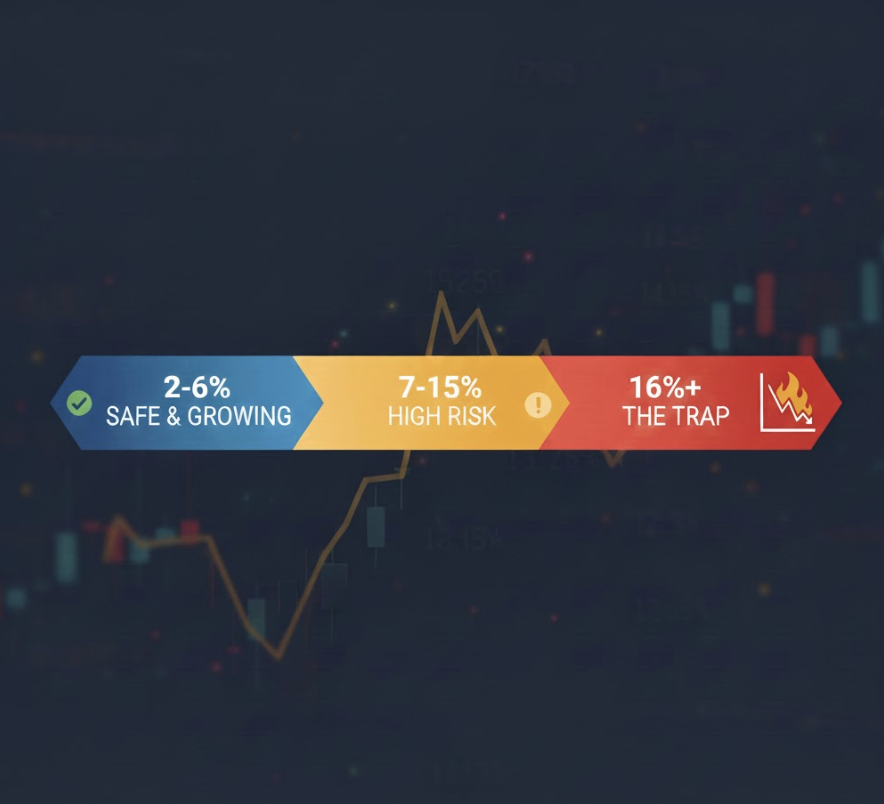
Many investors search for stocks with the highest dividend yields. Seeing 15% or 20%, they think: "Finally, passive income!"
Today, let’s break down why a high yield is often a distress signal and how to find truly reliable payments.
What is a Dividend Trap?
When a company is in trouble, investors sell off its shares. As the price drops, the dividend yield automatically shoots up.
📌📋Real-World Example: In 2023, Walgreens (WBA) showed a tempting yield of nearly 9%. While investors chased the "cheap" income, the company was struggling with debt and legal settlements. Eventually, they slashed the dividend by 48%, and the stock price continued its collapse. This is the classic trap: chasing a 9% yield only to lose 40% of your capital.
💡 Quick Fact: In a stable economy, a yield above 8–10% in USD is an anomaly. Most likely, the market is certain the company will soon cut or cancel payments. You buy for the 15% yield, but tomorrow the company cancels dividends, and the stock price drops another 30%. You are in a trap.
The Golden Rule: 2-6%
It is recommended to look for the "Sweet Spot."
👍Recommended Range: 2–6%. Payments in this range are usually made by companies that are profitable enough to reward shareholders but still have cash left to grow the business.
Three Health Checks for Your Dividends
📊To avoid the trap, use these three indicators available in our Smart Dividend Screeners:
1️⃣Key Financials (Cash to Debt & PE): A "cheap" stock is only a good deal if it has strong fundamentals. PE Ratio & Cash to Debt
2️⃣Economic Moat Analysis: Reliable dividends come from companies that can protect their profits. Look for Strong Moat.
3️⃣World Events & Trends: Dividends don't exist in a vacuum. A company’s ability to pay can be boosted or crushed by global shifts. Check the Impact Score.
🤓Pro-fact: What if the Yield is 7–15%? When you see a yield in this range, you are entering high-risk territory. This may include the following, but there's more to it: 1) The yield is high only because the stock price has crashed. Investors expect a dividend cut; or 2) The company is giving away all its cash instead of fixing the business; or 3) High dividends are often paid using borrowed money when the "Cash to Debt" ratio is weak.
Bottom Line: Unless it’s a Real Estate or an Energy Partnership, a 10%+ yield is usually a "Value Trap".
💡Pro-Tip: Before you buy, ask: Has this company increased its dividend for at least 5-10 years? Companies that take pride in their "dividend streak" will do almost anything to avoid cutting it, as a cut signals failure to the entire market.
⚠️ History Lesson: The GE Disaster General Electric paid dividends for over 100 years. Investors felt safe until the company cut the payout to just $0.01 in 2018. The stock crashed. Moral of the story: Even giants fall if their "Cash to Debt" ratio is broken.
Investing in the stock market is an incredible adventure, but without a reliable guide, it’s easy to get lost. Let ValueStocks.pro be your reliable guide.
Disclaimer: This content is for educational purposes only and is not financial advice. Always do your own research.